
Service-as-Software
Why the next SaaS-sized outcomes are hiding in high-touch businesses.

What do a boiler distributor, a boat broker, and a roofing company all have in common?
They all require sales reps to generate every dollar of revenue — in contrast to low-touch businesses, like Salesforce, that scale revenue through self-service automation.
The contrast is stark. Low-touch businesses generate 90% of their revenue through self-service automation, whereas high-touch businesses have a human involved in nearly every transaction. It's only natural that the power-law dynamics of capitalism would result in the "Magnificent 7" — seven low-touch companies that account for more than 30% of the value in the S&P 500.
The reason for this phenomenon is that, up until now, technology has only been able to scale business processes that cleanly fit into database tables. Businesses that figure out how to reduce customer choice into a "box" can scale with tech. For every other high-touch business, technology has only provided marginal improvements.
But as we'll illustrate in this post, a new era of technology is upon us, and it's changing the way business gets done. With the advent of GenAI "reasoning models," high-touch is now automatable — and has the potential to invert market caps. In this post, we'll illustrate how, and why we predict a movement toward high-touch.
How low-touch companies automate revenue
Let's illustrate the differences in revenue generation between a low-touch SaaS vendor (like Salesforce) and a high-touch business like an HVAC distributor.
An enterprise SaaS company and an HVAC distributor both deploy similar high-touch sales motions when acquiring new customers. Both employ highly paid sales teams to find, educate, and close a first-time customer. It's post-first-sale where the revenue differences emerge — and it's here where low-touch businesses thrive.
For both types of businesses, 90+% of annual revenue comes from repeat customers. What makes a SaaS company a "low-touch" business is that it can automate nearly 100% of this post-first-sale revenue without people (beyond discretionary spend for line items like customer success), whereas an HVAC distributor has a human sales rep involved in nearly 100% of its repeat transactions.
As a corollary, new customer purchases make up just 10% of annual revenue for both types of businesses — and a SaaS business can direct all of its precious high-touch resources toward finding new first-time customers, which it then runs through its revenue automation machine. An HVAC distributor, on the other hand, needs those same costly high-touch sales reps across both new accounts and repeat purchases.
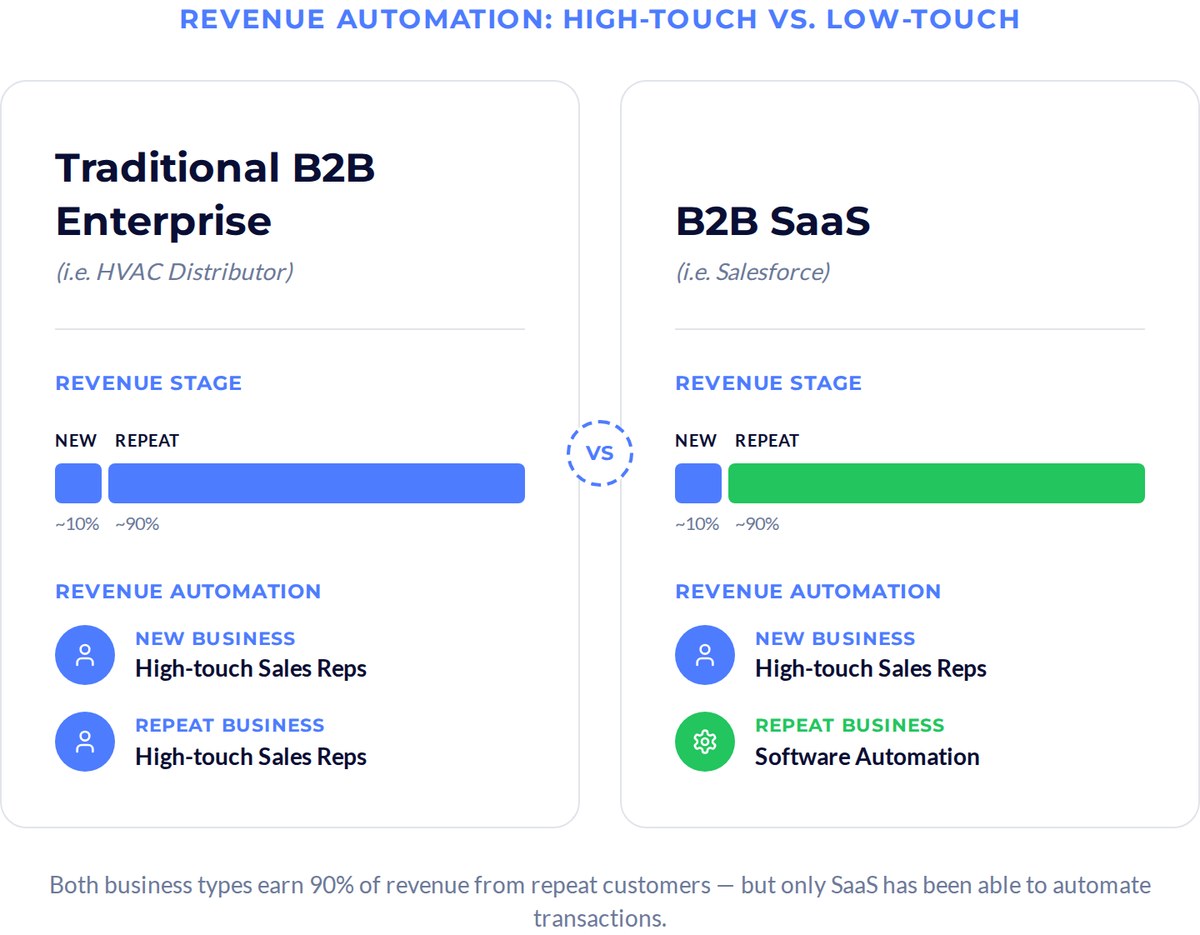
This post-first-sale revenue automation ability is the driving force behind the 10x multiple that low-touch businesses get over their high-touch peers, making it worth exploring the structural reasons behind the revenue quality gap. Let's consider three key reasons why B2B repeat transactions can't self-service their revenue through technology.
Why high-touch businesses can't automate revenue
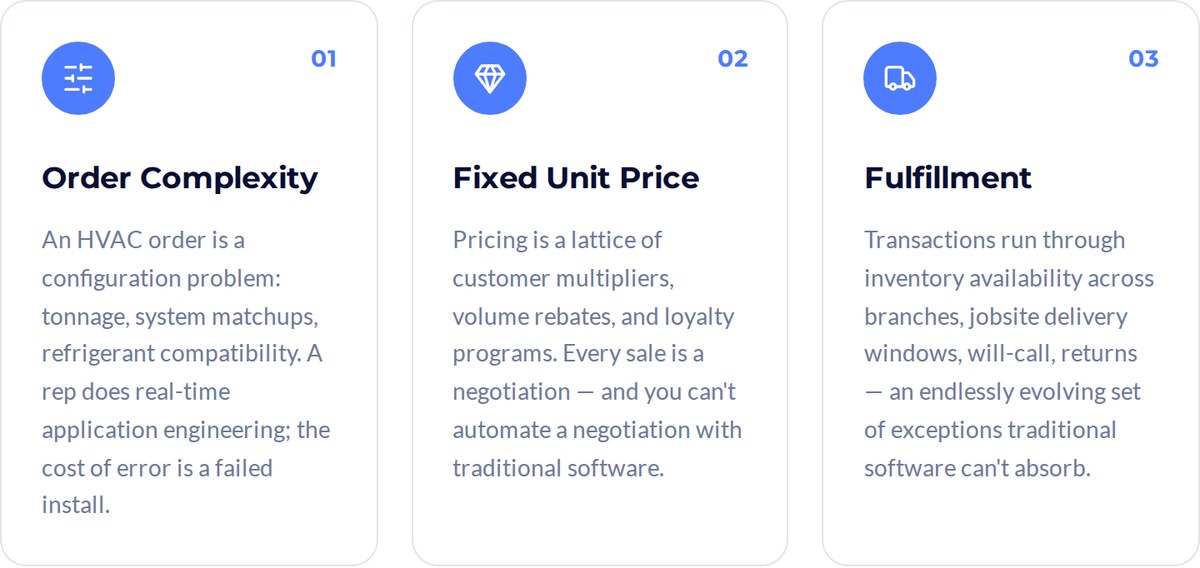
1. Order Complexity
For a low-touch SaaS business, the post-sale order placement is deterministic — the customer purchases more seats of a known edition at a known rate, and can't really order it "wrong." An HVAC order, in contrast, is a configuration problem: tonnage, system matchups, refrigerant compatibility, and more. A sales rep has to do real-time application engineering, and the cost of error is a failed install and a truck roll. This translates to pure margin for Salesforce versus a hefty commission for the HVAC distributor.
2. Fixed Unit Price
A SaaS company's post-sale pricing is fixed at contract signing, which means self-service automation can work because the price is already known. For the HVAC distributor, pricing is a lattice of customer-specific multipliers, volume rebates, job-level quotes, and loyalty programs. This requires a human sales rep to quote each transaction — you can't automate a negotiation with traditional enterprise software.
3. Fulfillment
SaaS delivers its product through instant provisioning with a near-zero exception rate. Compare this with an HVAC distributor, whose transactions run through inventory availability across branches, jobsite delivery windows, will-call, returns, and more — an endlessly evolving set of exceptions that traditional software can't automate.
There are more distinctions that follow from the above. SaaS business models renew automatically, while the HVAC distributor has to re-win the business. SaaS companies collect rich customer telemetry to inform expansion opportunities — data that doesn't exist for the HVAC distributor outside of the point of sale. But fundamentally, the revenue-scaling gap comes down to this: for the reasons above, high-touch businesses require a human to facilitate the transaction because traditional software can't cover the complexity.
How GenAI changes the opportunity to meet high-touch demand
To appreciate how things change with GenAI, we have to briefly distinguish between traditional "enterprise software" and "AI-native" business processes.
Enterprise software is what you see in SaaS tools like Salesforce: order form builders, email templating engines, and the like. Everything has to fit into a box for the SaaS tool to work.
AI-native software is different. When you prompt an AI-native service like Claude with a question, you can literally see it think through different options before giving you an answer. You interact with Claude very differently than you would Salesforce, and this encapsulates the difference: AI-native reasons through ambiguity, whereas traditional enterprise software requires deterministic rules. This distinction paves the way for high-touch automation.
Let's illustrate with an example from above: order complexity. Enterprise software can't negotiate the sale, because it requires structured inputs to fit into database tables — and an HVAC order arrives as an unstructured problem: "I've got a 2009 condenser on a coastal rooftop. What pairs with it under the new refrigerant rules, and can you get it to the jobsite by Thursday?" Resolving that into a valid order takes a back-and-forth that draws on tacit knowledge software has never been able to adequately capture: what's compatible with what, what this customer's pricing tier is, and what substitution he'll accept when the first choice is out of stock. A software portal can process a decision that's already been made — it can't participate in making one, and requires a salesperson to stay in the loop.
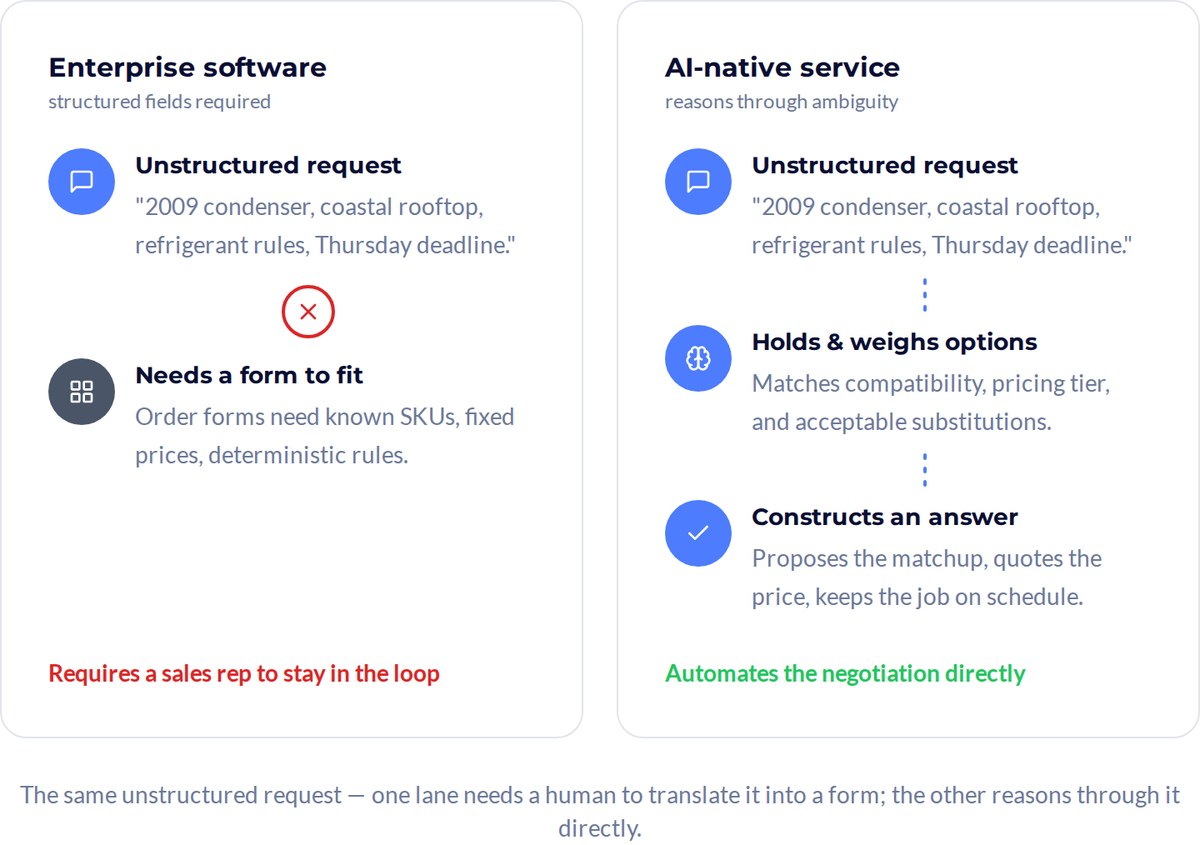
Now run the same call through an AI-native service. The contractor's unstructured problem — the 2009 condenser, the coastal rooftop, the Thursday deadline — is no longer a blocker, because reasoning models work the way the counter person does: hold the ambiguous request, weigh the options, and construct an answer rather than look one up. An AI sales rep that's been onboarded with the distributor's tacit knowledge can conduct the same back-and-forth: propose the matchup, flag the refrigerant issue, quote the customer's actual price, and offer the alternative that keeps the job on schedule. The negotiation doesn't disappear — it gets automated, which is the moment the order moves onto self-service rails.
The same high-touch automation carries through each of the post-sale challenges above. Where conditional logic and databases fall short, reasoning models — with proper training — handle it the same way a human rep would.
Of course, most high-touch companies haven't yet connected Claude (or an open-source model) to their proprietary data, because the necessary enterprise tooling is still emerging. Data needs to be restructured into knowledge graphs, and governance mechanisms need to be in place to ensure data isn't siphoned. But with so much business value at stake, the trajectory is simply a matter of time — more on that in a future post.
High-Touch: the future belongs to high-touch customer relationships
The implications from above are that many high-touch motions can now be automated (AI can't handle the register… yet). We considered an HVAC distributor in our example, but the same dynamics can be seen in brokers, franchise owners, and any company today that requires a human expert to guide the customer through a complex buying motion.
Further, rather than trying to fit customers into boxes, high-touch businesses will have the advantage of scaling what customer wallets have always preferred: 1-to-1 personalization. None of these businesses have been able to scale in the past; but just like database technology gave rise to highly scalable SaaS businesses, GenAI will allow high-touch service-based business processes to scale. Taking this vantage point, the frontier of business value will center around competing on customer relationships. Some things don't change.